Most homeowners return to a fire-damaged home, smell nothing alarming after a few days, and think the worst is over. It’s not. Smoke residue doesn’t announce itself; it seeps into wall cavities, bonds with furniture fibers, and circulates silently through your HVAC system long after the flames are out. The families who ignore it don’t just deal with a persistent smell. They deal with chronic respiratory illness, neurological symptoms, and contamination that compounds every single day without professional intervention.
Bio Clean, Inc. has seen what delayed action costs, and it’s always more than people expect.
This blog discusses what lingering smoke contamination is, why it’s far more dangerous than it seems, who’s at greatest risk, and what it takes to truly get rid of it, not just mask it.
What Is Lingering Smoke Contamination Indoors?
Smoke doesn’t exit a building the way it enters a room. It penetrates. Once a fire occurs, post-fire indoor pollution settles into every porous surface it can reach, often in spaces you’ll never think to clean.
1. How Smoke Residue Spreads Through a Property
Hot smoke travels through pressure differentials, meaning that it travels into wall cavities, ceiling voids, and air ducts, not just the rooms closest to the fire. Smoke particles in walls and furniture are microscopic. They don’t just sit on surfaces; they bond to them chemically, making simple wiping completely ineffective.
2. Why Smoke Damage Often Goes Undetected
The most dangerous contamination is the kind you can’t see or smell. Hidden smoke damage in homes hides behind electrical outlets, inside insulation, and deep within HVAC ductwork. Odor fading does not mean contamination removal; it often means the residue has just stopped actively off-gassing from the surface layer, but is still releasing toxins from deeper material layers.
Why Smoke Residue Is More Dangerous Than Many Homeowners Realize
Here’s what most people don’t know: the smoke from a structural fire contains hundreds of toxic compounds formed as synthetic materials, plastics, foam, and treated wood that combust simultaneously.
1. The Toxic Chemicals Found in Smoke Particles
VOCs from smoke residue include benzene, formaldehyde, and acrolein, several of which are classified as carcinogens. Alongside these, ash and soot particles carry polycyclic aromatic hydrocarbons (PAHs) and heavy metals from burned electronics and paints. They aren’t just temporary annoyances. They’re chemicals that are known to be linked to cancer, damage to organs, and neurological damage.
2. The Difference Between Smoke Odor and Active Contamination
Odor is the symptom. That’s because of contamination. In fact, a house can get rid of smoky odors and still register hazardous levels of particles. Families often mistake the absence of odor for safety and continue breathing airborne toxins after a fire for weeks without realizing it.
Think your home smells fine now? Smoke residue continues releasing toxic gases for months after a fire, completely odorless, completely invisible, and completely dangerous.
What Health Risks Are Linked to Lingering Smoke Exposure Indoors?
1. Respiratory Problems and Irritation
Respiratory irritation from smoke hits first and hardest. Fine soot doesn’t stop at the throat; it travels deep into lung tissue, well past what the body’s natural defenses can intercept. Chronic bronchitis, shrinking lung capacity, infections that keep coming back, these are the patterns doctors see in people who stayed in contaminated spaces too long without knowing it.
2. Long-Term and Neurological Effects
Long-term smoke exposure symptoms extend well beyond the lungs. Prolonged exposure to VOCs from smoke residue is linked to cognitive difficulty, mood disturbances, and memory issues. A smoke-contaminated home is not only uncomfortable, but medically dangerous when compounded with cardiovascular stress from breathing particulates.
3. Skin, Eye, and Sinus Irritation
Burning eyes, recurring sinus congestion, and skin rashes are classic poor indoor air quality symptoms that families living in contaminated homes routinely misattribute to seasonal allergies. Often, the actual source is still built into their wall.
Who Is Most Vulnerable to Indoor Smoke Contamination?
Not everyone in a smoke-contaminated home is equally at risk. Some members of your household take a lot more harm.
- Children and infants: Children and smoke exposure are particularly serious because they breathe more air relative to body weight. Their developing systems are far more sensitive to airborne toxins after fire, and even low-level exposure carries lasting developmental risk.
- Seniors: Aging lungs don’t filter contaminants the way younger lungs do, and most seniors already carry some degree of cardiovascular strain. Secondary smoke contamination at levels a healthy adult brushes off without much thought can trigger serious complications in an older person, hospital-level complications.
- People with asthma or allergies: Contaminated HVAC systems are catastrophic for those with pre-existing respiratory conditions. Every time the system runs, it redistributes fine particles throughout the entire home.
- Pets: Cats ingest surface toxins directly through grooming. Birds can suffer fatal respiratory consequences from post-fire indoor pollution that causes only mild irritation in humans.
Can Smoke Contamination Remain After Cleaning?
Why DIY Cleaning Falls Short
Standard cleaning products remove surface discoloration. They do not neutralize the smoke chemistry that is embedded in porous materials. Hidden smoke damage in homes, inside insulation, subfloors, and ductwork, is entirely inaccessible without professional-grade equipment.
Signs Your Home Still Has Smoke Contamination
- Smoky odor returns when the HVAC runs
- Walls and ceilings re-yellow after painting.
- Household members experience persistent poor indoor air quality symptoms with no other explanation.
- Lingering fire odor causes keep returning despite surface cleaning.
How Lingering Smoke Affects Indoor Air Quality
Contaminated HVAC systems are the primary reason smoke contamination spreads to every room in a property, including rooms untouched by the original fire. Residue coats duct interiors, and every heating or cooling cycle then circulates ash and soot particles and VOCs from smoke residue throughout the entire building.
Consumer air purifiers tackle airborne particles in one room. They cannot clean the inside of ducts or remove toxins from wall materials. They create a false sense of security, and contamination continues to off-gas under the surface, relying on them alone.
A smoke-contaminated HVAC system isn’t just a maintenance issue; it’s a delivery system, pushing invisible toxins into every room of your home every time it runs.
How Professional Smoke Remediation Protects Your Health
1. What Professional Smoke Damage Cleanup Includes
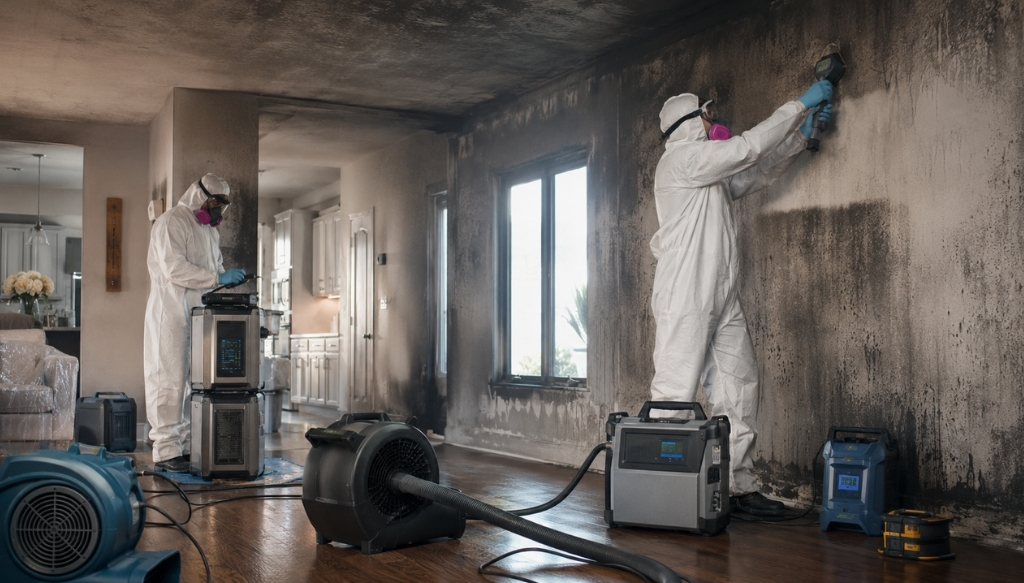
At Bio Clean, Inc., smoke cleanup and restoration are never surface-level. Our certified team conducts air quality assessments, uses HEPA containment systems, applies chemical neutralization to soot residue, and performs thermal fogging and ozone treatment to address lingering fire odor causes at a molecular level, not just masking them. Full HVAC decontamination and clearance testing are standard parts of our process.
Why Speed Is Non-Negotiable
Within days, acidic soot begins permanently etching surfaces. Within weeks, smoke particles in walls and furniture chemically bond to materials, requiring far more invasive removal. Delayed action always means greater damage and greater health exposure. For smoke damage restoration in Seattle, WA, Everett, WA, Renton, WA, Bellevue, WA, and Bellingham, WA, our team responds quickly because we know what every hour of delay costs.
Common Mistakes Homeowners Make After Smoke Damage
- Assuming the odor will fade: It won’t. Without removing the source, lingering fire odor causes persist indefinitely. Ventilation dilutes temporarily; it doesn’t eliminate.
- Repainting without cleaning first: Paint covers stains for weeks. Then discoloration bleeds through again, and VOCs from smoke residue continue off-gassing right through the new coat.
- Ignoring the HVAC system: Skipping duct decontamination means choosing to redistribute secondary smoke contamination every single time your system runs.
- Delaying cleanup: This is the most costly mistake. Every 24 hours increases the depth of contamination and the complexity of remediation.
Smoke Contamination and Soot Damage: Understanding the Difference
These two terms get used interchangeably, but they represent distinct indoor environmental hazards that require separate treatment approaches.
| Smoke Residue | Soot Deposits | |
| Composition | VOCs, chemical gases, fine particles | Concentrated carbon, PAHs, heavy metals |
| Primary Hazard | Chemical off-gassing, carcinogen exposure | Direct inhalation, surface corrosion |
| Where It Hides | Walls, ducts, insulation, furniture | Surfaces, ceilings, vents |
| DIY Removable? | No | No |
Both require certified equipment and clearance testing. Neither is solved by consumer cleaning products.
Your Health Cannot Wait for the Smell to Return.
Smoke contamination doesn’t follow a predictable timeline; it quietly compounds. The long-term smoke exposure symptoms families experience are rarely connected back to the fire that happened weeks ago, because by then, the home looks completely normal. That gap between visible damage and invisible harm is exactly where the real danger lives. Post-fire indoor pollution doesn’t declare itself. It accumulates.
Bio Clean, Inc. is a locally owned biohazard remediation company that has been serving Washington communities through some of their most difficult moments. Our certified team brings both technical expertise and real compassion to every smoke cleanup and restoration job, because getting a property visually clean and getting it genuinely safe are two very different outcomes. Air quality assessments, HVAC decontamination, clearance testing, we don’t skip steps.
If your property has experienced smoke damage, whether recent or months ago, don’t wait for symptoms to confirm what the residue is already doing. Contact Bio Clean, Inc. today at (888) 412-6300 and let our team assess what’s actually in your air.